There’s an old assumption baked into how we drive: a license plate is anonymous to strangers. Someone can memorize it, photograph it, even follow you for a while — but they can’t turn those seven characters into your front door. That assumption is correct. What almost nobody has updated is the realization that your face now does exactly what your plate can’t.
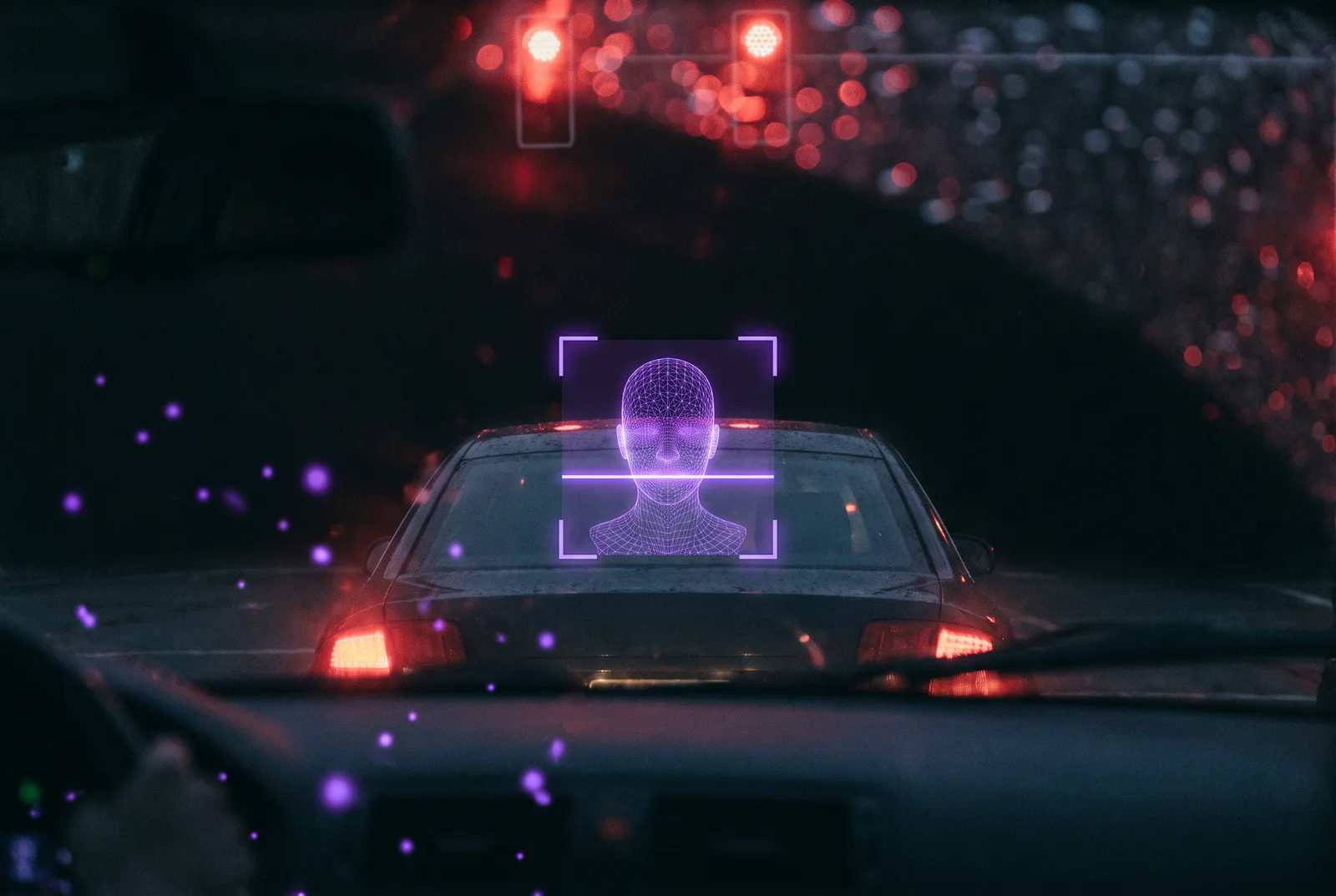
The plate is a locked door
Here’s the part that still works in your favor. License-plate data is protected. In the U.S., the Driver’s Privacy Protection Act restricts who can pull your name and address from your plate — law enforcement, courts, licensed investigators with a permissible purpose. A random person who photographs your plate hits a wall. They can’t type it into a public box and get your home.
That gate is real, and it’s why plate anonymity has held up for decades. The problem isn’t that the plate got easier to crack. It’s that a second identifier — one with no gate — started riding in the driver’s seat, in plain view through the windshield.
The face is a wide-open one
There is no Driver’s Privacy Protection Act for your face. Nothing gates it. A clear photo dropped into a face-search engine like PimEyes or FaceCheck.ID — the exact engines FacePrivacy submits opt-outs to — compares it against a giant index scraped from the open web and hands back the pages where your face appears. From there it’s a short walk:
- Face → name. The engine ties the windshield photo to a tagged photo, an old profile, a public bio — and now the stranger has your name.
- Name → address. A people-search broker (also open, also cheap) turns that name into your home address, phone number, and relatives.
- Total cost: a photo and roughly a dollar. No badge. No reason. No record that it happened.
From red light to your driveway
This is where a digital lookup becomes a physical problem. The stranger at the light already knows what you drive — it’s right there. What they were missing was where. Your face fills that in. Now they have the car and the location, which is the entire shopping list for targeting a vehicle at home — a car thief no longer has to get lucky in a parking lot; they can go straight to the driveway of the exact car they picked out.
And it doesn’t stop at the car. The same face-to-address chain is what turns a fleeting encounter into a follow-home: the driver you honked at, the person who took offense at a parking space, someone who simply decided they wanted to know more about you. None of them have to tail you through traffic anymore. They let the databases do the following.
Tint and plate covers won’t save you
The instinct is to protect the plate — a cover, a spray, a frame that blurs at an angle. It’s the wrong door. The plate was already gated; you’re reinforcing a lock that was holding. Meanwhile the actual opening — your face, lit up behind the windshield at every light — stays wide open. You can’t tint your way out of a problem that lives on a server, not on your car.
The only thing that closes the real door is making the face search come back empty. If your faceprint isn’t in the engines, the windshield photo has nowhere to resolve to — the chain breaks before it produces a name, and a name is the only thing the address lookup can use.
Take your face out of the index
That’s the whole job FacePrivacy does. We file opt-out and removal requests with the major facial-recognition engines — PimEyes, FaceCheck.ID, Lenso.ai and the rest — log the confirmations, and re-file when a fresh scrape puts you back. We can’t stop someone from pointing a phone at your car. What we can do is make sure that when they run the photo, it returns nothing to point them home.
Your plate is protected by law. Your face should be protected too — and until the law catches up, the only version of that protection you can actually get is not being in the index in the first place.
Make the windshield photo a dead end.
FacePrivacy removes your faceprint from the major face-search engines and keeps it removed — so a photo of you at a light stops turning into your name, your address, and your driveway.
Protect your face →