Let’s be clear up front: we love this stuff. Anything that annoys a facial-recognition system is doing the Lord’s work, and the people building these gadgets are clever, creative, and on the right side of the fight. We are not here to dunk on them.
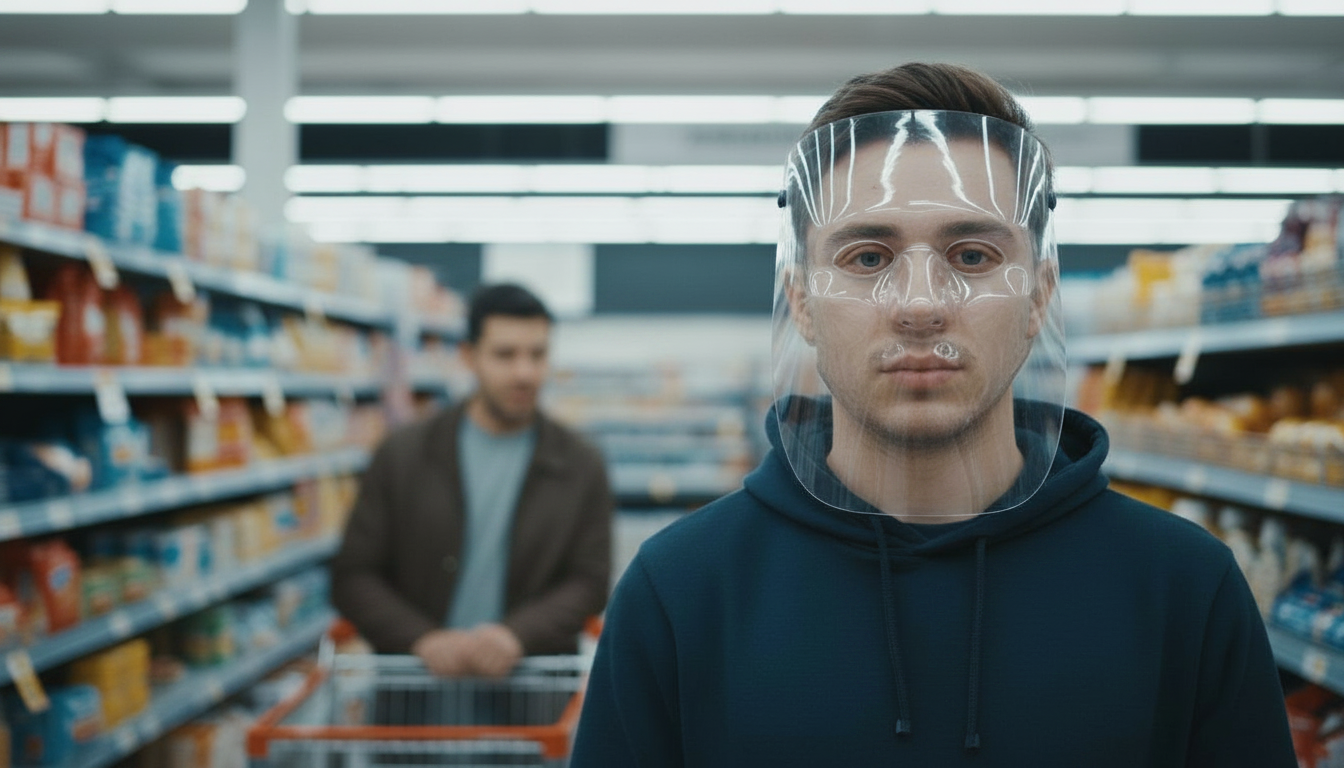
We are here to gently point out that a transparent full-face shield is a fantastic thing to wear in a studio photoshoot and a deeply cursed thing to wear at a coffee shop. The gap between “viral demo” and “actual daily privacy” is enormous, and it’s worth being honest about it.
A field guide to anti-recognition cosplay
The genre is bigger than the one mask that went viral. A quick tour of the exhibits:
- The transparent face shield. Prints a slightly-wrong 3D version of a face over your own so detectors lock onto the decoy. Looks like you’re cryogenically freezing your head. Fogs up when you breathe.
- CV Dazzle makeup. Angular high-contrast face paint that breaks up the features detectors look for. Genuinely artful. Also announces to every human within 100 meters that you are Up To Something.
- Infrared LED glasses and hats. Tiny IR lights that blind cameras while staying invisible to people. Clever! Requires a battery pack, only works on cameras that see IR, and does nothing in bright daylight.
- Adversarial-pattern hoodies and shirts. Clothing printed with noise that confuses object detectors into not seeing a person at all. Works in the lab against one specific model, on a good day, from the right angle.
- Projector and mask hybrids. Rigs that beam patterns onto your face. Now you’re wearing a projector to brunch.
Every one of these is a real, working proof of concept. And every one of them is a costume.
The “wear it forever” problem
Here’s the thing nobody in the demo video mentions: for a wearable to protect your privacy, you have to actually wear it. Constantly. Everywhere a camera might be. Which is everywhere.
- You’d never take it off. Your face is exposed the second you sit down at a restaurant, walk into a friend’s house, or take a selfie. One un-masked moment and the whole thing is pointless.
- Half of these places ban masks anyway. Banks, airports, many stores, and plenty of events will not let you cover your face. The literal place you’d most want privacy is the place you’re least allowed to hide.
- It solves the wrong 1%. The tiny sliver of your life spent walking past a live public camera is not where your face leaks. Your face leaks from the internet — photos other people posted, tagged, and uploaded, all with your bare, un-masked face.
A privacy tool you have to remember to wear, that people are staring at, that gets you stopped at the door, and that only covers you for the few minutes you have it on… is not a privacy tool. It’s an outfit.
You’re fighting the wrong camera
This is the part that actually matters. Anti-recognition wearables are built to defeat a camera in the moment — the CCTV on the corner, the phone pointed at the crowd. But that is not how face-search engines get you.
Engines like PimEyes, FaceCheck.ID, and the rest didn’t follow you down the street. They scraped the open web — every public photo of your face, going back years — and turned each one into a faceprint: a numeric template of your features. That faceprint is sitting in their index right now, with your bare face, no mask in sight.
The boring thing that actually works
The unglamorous truth is that real face privacy isn’t a gadget you wear — it’s getting your faceprint out of the databases that already hold it. No costume, no battery pack, no explaining yourself at the bank.
That’s the whole job FacePrivacy does. We file opt-out and removal requests with the major facial-recognition engines, log the confirmations, and re-file when your face gets re-scraped — so a photo of you stops turning into your identity. It won’t make you invisible to a camera on the street, and we’d never pretend it does. But it fixes the part that actually leaks: the record.
Wear the cool mask if you want — honestly, it’s rad. Just don’t mistake a photoshoot prop for a privacy plan.
Get your face out of the databases — no mask required.
FacePrivacy removes your faceprint from PimEyes, FaceCheck.ID, Lenso.ai and the other major face-search engines, and keeps it removed — so no photo of you becomes a shortcut to your identity.
Protect your face →