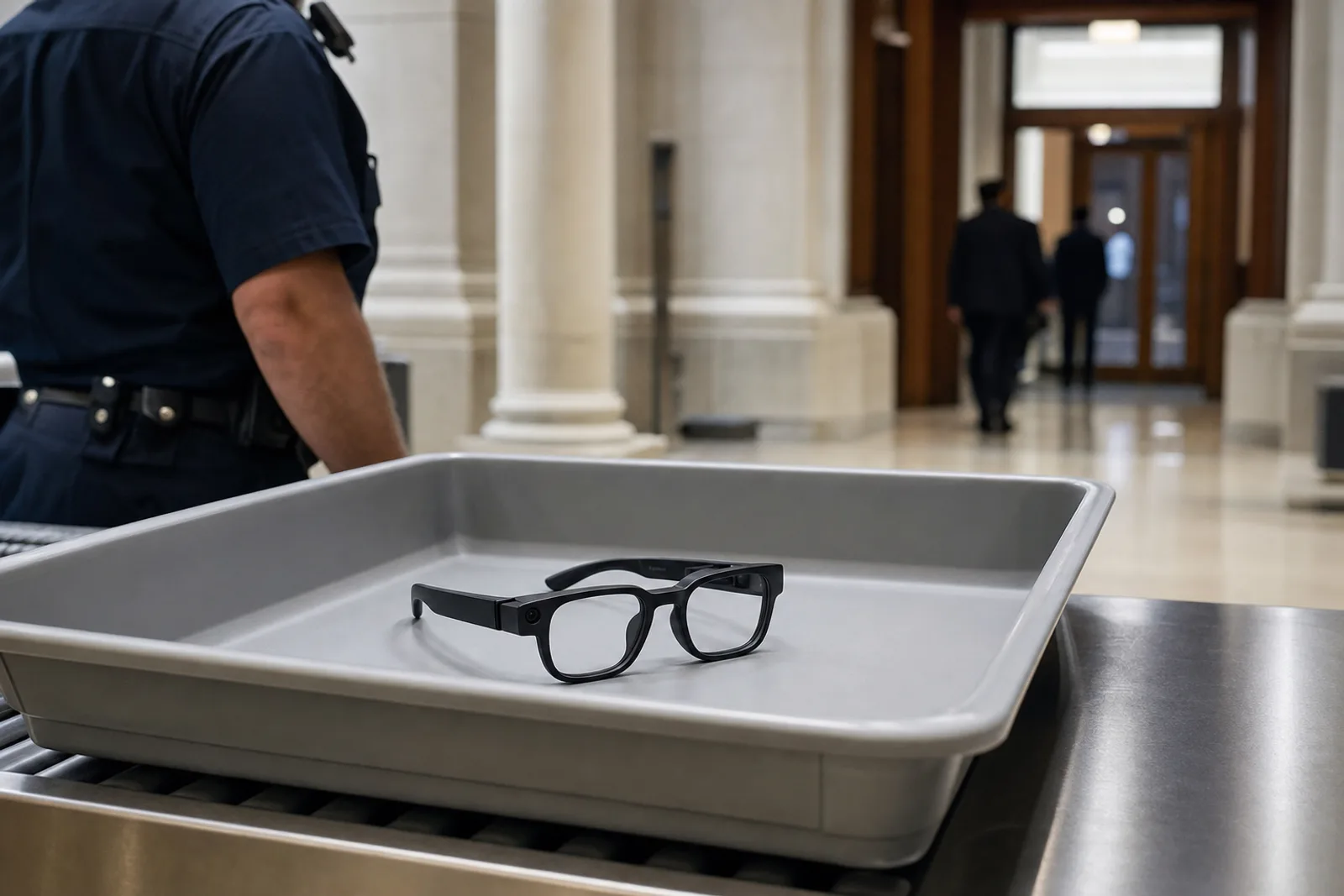
For a technology that supposedly slipped in unnoticed, camera glasses have collected prohibitions at remarkable speed. Philadelphia's courts barred recording-capable eyewear from court buildings starting in late March. New York went considerably further in July, prohibiting smart glasses and other recording-enabled eyewear across more than twelve hundred courthouses — reportedly the first state to apply it to all of them at once. Casinos, airlines, schools, workplaces and hospitals have been working through their own versions.
Who banned them, and when
The list has an obvious shape once you write it out. Courts. Casinos. Examination halls. Secure workplaces. Hospitals. Airlines. Financial institutions.
Every one of those is a place where an organisation has clear authority over who comes in and what they carry, and where recording threatens something the organisation itself cares about: the integrity of proceedings, the security of a gaming floor, the validity of an exam, patient confidentiality as a matter of the hospital's own legal exposure. The rules were not hard to write because the harm was easy to articulate and the party harmed had standing, lawyers, and a door.
That is not cynicism about the bans. A courthouse prohibition is genuinely valuable — witnesses, jurors and people attending the worst days of their lives should not be covertly recorded. The point is narrower and worth stating precisely: these rules exist because institutions protected themselves, and you happened to be standing inside the protection.
The pattern in who moved first
Sort the ban wave by how quickly each place acted, and it correlates almost perfectly with how concentrated the harm is.
A court can name exactly what goes wrong: a witness is recorded, the recording circulates, future witnesses stop coming forward, the process breaks. One identifiable institution absorbs the damage, so one institution fixes it. Same for a casino, an exam board, a hospital.
Now try to write the equivalent for a bus stop. The harm is real but it is spread across thousands of people, none of whom knows it happened, arriving at unpredictable times, with no single body responsible for the space and no obvious rule that would not also ban ordinary phones. There is nobody to be the plaintiff, so there is nobody to be the rulemaker. The harm is not smaller out there. It is just diffuse, and diffuse harms do not generate rules on their own.
The rooms nobody is writing rules for
Add up the protected spaces and they cover a vanishingly small fraction of a life. Most people go years without entering a courthouse. The places where you are actually seen by strangers all day — pavements, trains, cafés, gyms, shops, parks, the queue for coffee, the school gate, the pharmacy counter — have no rule and no realistic prospect of one.
Those are also, by an enormous margin, where the photographs that end up in face-search indexes come from. Not from courtrooms. From ordinary places, in ordinary moments, mostly by accident, increasingly by devices that are not being pointed.
A ban protects the moment, not the record
Here is the limit that applies even to the strongest rule on the list, and it is the reason we think the ban conversation, while worthwhile, is not the one that decides your outcome.
Every prohibition above governs capture. Do not bring the device in, do not record here, hand it over at the desk. None of them governs matching — and matching is a separate act, performed later, somewhere else, by a different system, using an image that may have been captured entirely lawfully somewhere with no rules at all.
A photo of you taken legally at a street festival in 2019, uploaded by someone you never met, is the input. Whether a courthouse allows glasses in 2026 has no bearing on it. The lookup that turns that image into your name, your employer and your neighbourhood runs against an index that was built from public web scraping, and no capture rule reaches backwards into it.
So capture rules and identification are two different problems, and every institution that has acted so far has acted on the first one. The second is where the durable exposure lives, because a photograph is a permanent object and the index does not forget.
Why recording law doesn't help you here
People reasonably assume existing recording law fills the gap. It mostly does not, for two structural reasons worth knowing.
The first is that the strong consent rules in US law are overwhelmingly about audio. The two-party consent states everyone has heard of are wiretapping statutes, concerned with intercepting conversations. Video of people in public sits under a much weaker standard, and a still frame of your face in a public place is close to the least protected thing in the entire category.
The second is that these laws are about the act of recording, and your problem is not that a recording exists. It is that an image of your face can be resolved to your identity by a stranger with no relationship to whoever took it. Nothing in a wiretapping statute addresses a commercial database indexing faces scraped from the open web.
The laws that do speak to this — biometric statutes of the kind Illinois pioneered and a handful of states have since passed — are aimed at the databases rather than the cameras, which is the right target. They are also slow, patchy by geography, and in most cases enforced long after the exposure. We have written before about why a law being passed and your face being deleted are not the same event.
What's left that you control
Three honest conclusions from all of this.
The bans are good and you should not expect them to reach you. Support them, be glad they exist in courtrooms, and do not build a plan around a rule arriving for the pavement. It is not coming, because there is no institution whose own interests would produce it.
Capture is already lost, and it was lost before the glasses. Between phones, doorbells, dashcams, transit cameras and everything else, the number of photographs containing your face has been outside your control for years. Camera glasses change the volume and the deniability, not the fundamental position.
Identification is a different system, and it has a door. The face-search engines that turn an image into a name are specific companies running specific databases, and they have removal processes. Awkward, inconsistent, individually documented removal processes that most people never complete — which is precisely why this service exists. Getting out of those indexes does not stop a single camera. It breaks the step where a stranger's photograph becomes your address.
The courthouses protected their proceedings. Nobody is going to write the rule that protects you in the queue. That part you have to do yourself, and unlike almost everything else on this page, it is available today.
You can't ban the camera. You can leave the index.
FacePrivacy finds where your face is indexed across the major face-search engines and files removals to get you out, then keeps checking so a fresh scrape doesn't quietly put you back.
Check my exposure