Why companies scrape faces
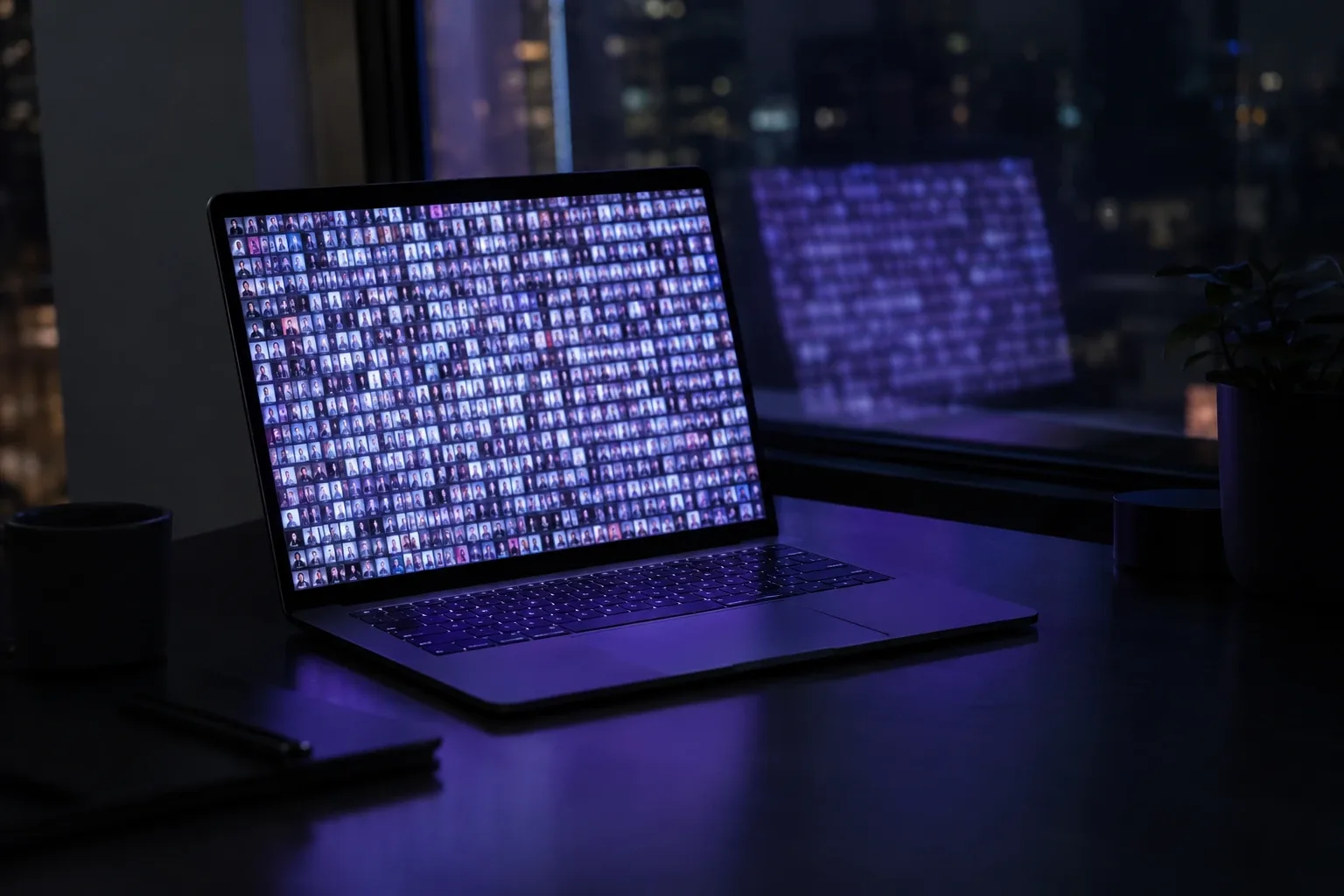
Scraping means software copies photos from public web pages in bulk. A face search company then turns each face into measurements, so a new photo can be matched against all of them. The people in those photos aren’t asked or paid, and the company earns money in three main ways:
- Subscriptions. PimEyes lists plans from 10 searches a day on its free tier to unlimited on its top plan, and it claims more than 500,000 users (PimEyes plans page).
- Search credits. FaceCheck.ID sells credits that unlock more results per search (FaceCheck.ID).
- Government contracts. The US government’s spending database lists 22 federal contracts with Clearview AI since late 2019, worth about $12.4 million as of November 2, 2026. The largest is a $7.69 million contract with Immigration and Customs Enforcement that runs to September 2027.
The bigger the collection, the more a search can find. Clearview’s site now claims more than 100 billion images (Clearview AI, its own figure).
Where data brokers fit
Data brokers collect details about people and sell them. When the Federal Trade Commission studied nine brokers, it found billions of data elements covering nearly every US consumer, sold as marketing lists, risk and fraud tools, and people search (FTC).
Brokers and face search engines are usually separate businesses, which is why data broker removal services don’t cover your face. The risk grows when someone uses both. In 2024, two Harvard students paired camera glasses with PimEyes and other lookup tools, and could go from a stranger’s face to a name, phone number, home address and family members (404 Media).
The pros: where it helps
Spotting fake profiles
The FTC tells people worried about a romance scam to run a reverse image search on the person’s profile picture and see whether it appears under another name (FTC). A face search can go further, because it can match a different photo of the same person.
Catching identity fraud and fake IDs
Banks have to verify who their customers are, usually with a government photo ID, and fraudsters now use AI to fake those documents. US Treasury’s financial crimes unit lists a useful warning sign: a reverse image search showing that an ID photo matches a gallery of AI-generated faces (FinCEN alert).
One thing to keep separate: the usual bank check compares your selfie with your own ID, with your knowledge. That check needs no database of strangers. The EU’s AI Act draws the same line, treating verification of a claimed identity differently from identifying someone against a database (EU AI Act, Annex III).
Finding mugshots and offenders
FaceCheck.ID says it checks photos against mugshot and sex offender websites, so someone can check a person before meeting them (FaceCheck.ID). In the US, the Justice Department also runs a free public offender website that searches by name and location.
Helping investigators
Federal agencies buy this for real casework. One US Marshals Service contract describes its purpose as apprehending fugitives (USAspending).
Finding your own photos
You can’t ask anyone to remove a photo you don’t know exists. Searching your own face shows you where to start, and our self-check guide walks through it.
The cons: where it does harm
Nobody asked you
Twelve privacy regulators warned in 2023 that scraped data can be used to fill facial recognition databases, and for identity fraud and for monitoring and profiling people. They also said public posts are “still subject to data protection and privacy laws” in most places (joint statement, Privacy Commissioner of Canada).
A photo can lead to your front door
The same search that exposes a scammer works for a stalker or an angry ex. All they need is one photo of you, and as the Harvard demonstration showed, a face can lead to a home address.
Wrong matches hurt real people
Detroit police arrested Robert Williams in 2020 after software matched an old driver’s license photo of him to grainy store footage. The charges were dropped, and the city’s 2024 settlement changed how its police use the technology (Michigan Public). That match came from a license photo, and a scraped photo can be mismatched in the same way.
Accuracy also varies. The US National Institute of Standards and Technology tested 189 algorithms and found false positive rates that often differed by 10 to 100 times across demographic groups in one-to-one matching, depending on the algorithm (NIST).
A mugshot records an arrest, and it can follow you
California charged the alleged operators of Mugshots.com with extortion in 2018. Prosecutors said the site kept arrest records up until people paid a removal fee, even after dismissed charges or mistaken arrests, and collected over $2 million from about 5,703 people nationally (California Attorney General).
You can’t change your face
If a password leaks, you can reset it. You have no such option with your face, so a copy made today can still match you years from now.
Getting out takes work
Each engine has its own opt-out, and an opt-out covers that engine’s results only. PimEyes says it can’t remove a photo from the site hosting it (PimEyes opt-out form), and it also lists a paid takedown add-on on one of its plans (plans page).
Side by side
| Use | The benefit | The catch |
|---|---|---|
| Fake profile checks | Exposes a stolen or borrowed photo | The same tool lets anyone look you up |
| Identity checks (KYC) | Helps catch fake IDs and AI-made faces | The usual selfie-to-ID check needs no scraped faces |
| Mugshots and offenders | A quick check before meeting someone | An arrest is not a conviction, and old records linger |
| Police and investigators | Leads in real cases | A bad match can mean a wrongful arrest |
| Finding your own photos | Shows you what to remove | You have to upload your face to search |
Where the law stands
- European Union. Since February 2025, the AI Act has banned AI systems that build facial recognition databases through untargeted scraping of facial images (Article 5). Regulators have fined Clearview in France, Italy and Greece (€20 million each) and the Netherlands (€30.5 million).
- Canada. Four privacy regulators found in 2021 that Clearview collected images without consent, and that the “publicly available” exception did not apply (Privacy Commissioner of Canada).
- United States. There is no single federal law, so it depends on the state. Illinois and Texas have biometric laws, and Texas secured $1.4 billion from Meta under its law.
For your own country or state, see our privacy law pages.
What you can do about your own photos
- Search yourself. Our self-check guide covers where to look.
- Opt out of each engine. Use our guides for PimEyes, FaceCheck.ID and Social Catfish, or have us file for you.
- Take down the original. An opt-out leaves the source photo online, so ask the site that posted it to remove it.
- Clear data brokers separately. California residents can send one deletion request to over 650 registered brokers through DROP. It matches on details like your name, phone number and email, and it doesn’t cover public records (CalPrivacy).
Common doubts
“My photo is public. Doesn’t that make it fair game?”
In most places, no. The regulators’ joint statement says public posts are still covered by privacy law in most jurisdictions, though what you can enforce depends on where you live.
“Is all face matching bad?”
No. A check you choose, like unlocking your phone with your face, works very differently from a stranger searching for you.
“Will an opt-out delete my photo from the internet?”
No. It covers that engine’s results, and the original stays up until the site hosting it takes it down.
“Can FacePrivacy remove the original photo?”
No. We file opt-out requests with the face search engines we support and re-file them as necessary. Results depend on each engine.
“What does that cost?”
US$9.99 a month, or US$7.99 a month billed annually. Cancel from your dashboard whenever you like. Web payments made through Stripe carry a 30-day money-back guarantee.
Have your face opt-outs filed for you.
Upload two photos. We file opt-out requests with the face search engines we support and re-file them as necessary.
Opt my face out of face search →Facts in this post come from USAspending.gov (federal contract totals checked November 2, 2026), the Federal Trade Commission, FinCEN at the US Treasury, the US Justice Department, NIST, the California Attorney General, CalPrivacy, the Illinois and Texas legislatures, the Texas Attorney General, the EU AI Act, regulators in France, Italy, Greece and the Netherlands, and the Privacy Commissioner of Canada. Figures about PimEyes, FaceCheck.ID and Clearview AI are those companies' own claims from their websites. The Harvard demonstration is from 404 Media, and the Robert Williams case is from Michigan Public.