Here is the good news first, because most articles on this topic never get around to it: the facial recognition you use every day, the one that unlocks your phone and approves your payments, is one of the safer things you own. It is not the reason a stranger can find you. Those are two separate technologies that happened to inherit the same three words, and treating them as one thing leads people to fear the harmless one and ignore the one that actually matters.
Two things, one name
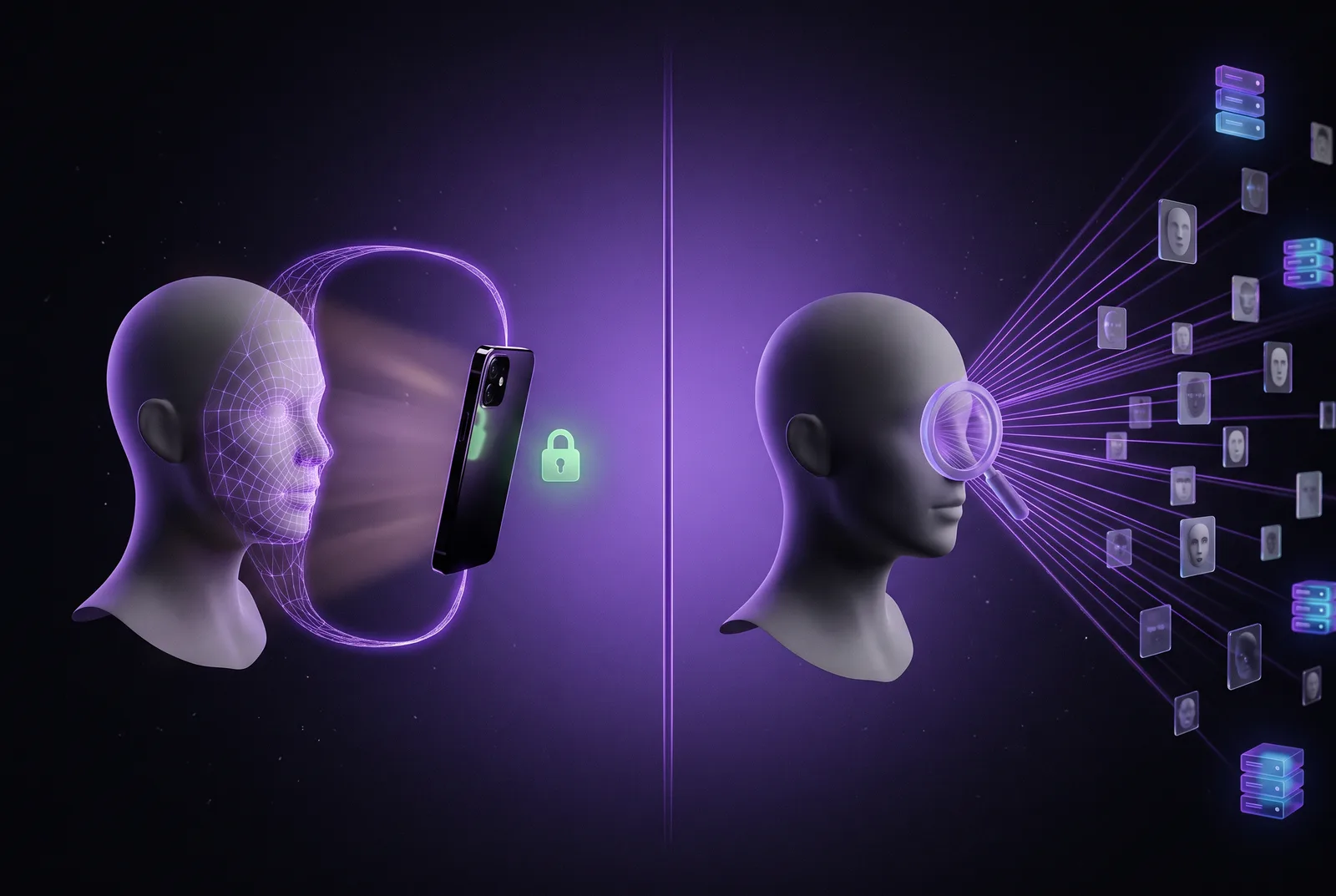
“Facial recognition” is doing a lot of quiet work in headlines. It gets used for the sensor on your phone and for the engine a stalker uses, as if they were the same product with a different logo. They are not. They differ on the questions that actually matter: what they are trying to answer, where the answer is computed, who is allowed to run them, and what they hand back when they finish.
Get those four straight and the fear sorts itself into the right pile. You end up keeping the convenient thing and removing yourself from the harmful thing, instead of doing the reverse, which is what a lot of people accidentally do.
Face unlock is a lock, not a search
When you set up Face ID or an Android face unlock, your phone builds a mathematical description of your face and stores it in a protected part of the chip. Apple calls this the Secure Enclave. From then on, unlocking is a yes-or-no question with exactly one candidate: does the face in front of the camera match the one enrolled owner? This is what engineers call one-to-one matching, or verification.
Three things make it safe. The comparison happens on the device, so the template does not get uploaded to a company’s servers. It only ever tests against you, not a crowd, so it cannot tell anyone your name. And it runs because you asked it to, by looking at your own phone. It is a key cut for a single lock. A key is not a directory of every door in the city.
Face search is a search, not a lock
A face-search engine is the opposite design in every one of those four ways. It answers a different question: not “is this the owner?” but “who is this, out of everyone we have indexed?” That is one-to-many matching, or identification, and to do it the engine first has to build the many. It scrapes billions of public photos, from social profiles, news pages, forums, and old accounts you forgot about, and reduces each face to a template it can rank against.
The answer is not computed on your device, because you are not involved at all. It runs on the company’s servers, on an index built from photos other people posted. Anyone who pays can point it at a photo of you. And what it returns is not yes or no. It returns identity: the other pictures that match, and through them your name, which a people-search site then turns into an address. That is the whole distance from “a face” to “a doorstep,” and none of it touched your phone.
Why one is safe and one isn’t
Line the two up and the difference stops being about the technology and starts being about power. Face unlock gives power to you: you enrolled, you hold the key, the match stays with you. Face search gives power to strangers: they built the index from photos you never chose to hand over, and they can run it without you ever knowing it happened.
- Question: unlock asks “is this the owner?” Search asks “who is this person?”
- Scope: unlock tests against one enrolled face. Search tests against billions.
- Location: unlock decides on your device. Search decides on someone else’s servers.
- Consent: you trigger the unlock. A stranger triggers the search.
- Output: unlock returns yes or no. Search returns your identity.
That last row is the one that costs people. A lock that says yes or no cannot leak who you are. A search built to return identity does nothing but.
So what should you actually do
Keep using face unlock. It is convenient, it keeps your phone locked to you, and it is not feeding the thing you are worried about. If it makes your day easier, that is the correct call.
The layer worth your attention is the search index, because that is the one a stranger can aim at you. You cannot un-post every photo other people took of you, and you should not have to swear off ever appearing in a picture again. What you can do is get your faceprint out of the engines that make those photos searchable, so a photo of you resolves to nothing instead of to your name.
Keep Face ID. Lose the search result.
FacePrivacy files removal requests with the major face-search engines and re-files as they re-crawl, so the harmful kind of facial recognition comes back empty while the useful kind keeps unlocking your phone.
Protect your face →