Think about the last ten photos of you that went online. How many did you upload? For most people the honest answer is one or two. The rest came from a friend’s camera roll, a company’s recap post, a photographer’s gallery, or a group chat that someone screenshotted into a story. Your face privacy is, to a surprising degree, in other people’s hands.
That isn’t an argument for being difficult at parties. It’s just worth naming, because almost every privacy guide ever written assumes you control the upload button. Once face search enters the picture, the person pressing the shutter is making a decision on behalf of everyone in frame — usually without realizing there’s a decision to make.
The uncomfortable math
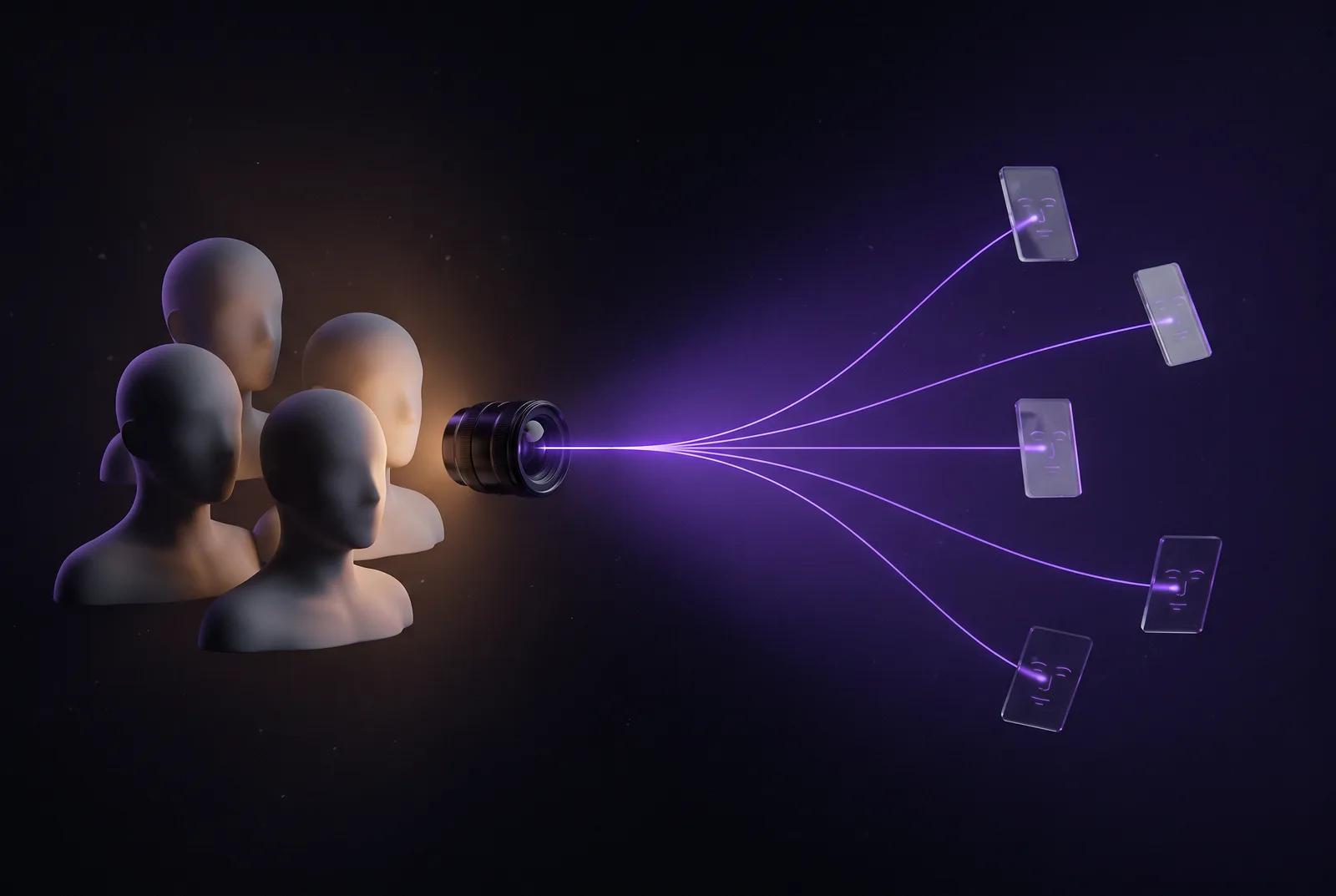
A photo of one person creates one searchable record. A photo of eight people at a wedding creates eight. Every face in the frame gets detected, cropped, converted into a faceprint, and filed — independently. The engine doesn’t care whose camera it was or who the photo was “about.” A bridesmaid in the third row is just as indexed as the couple.
This is why group photos punch so far above their weight. A single conference recap post with forty people in it can put forty new faceprints into circulation in an afternoon. Nobody in that photo consented to being biometrically indexed. Most of them were just standing near a banner.
Why group shots are especially good training material
There’s a technical reason group photos matter more than their share of the internet suggests. Face-search engines match best when they have several angles of the same person under different lighting. A group photo delivers exactly that at scale: people turned at slightly different angles, some laughing, some mid-blink, all lit by the same room.
Add the fact that group photos are almost always captioned with names — tagged at a wedding, listed in a company post, credited in a gallery — and you have the single most useful kind of image a face index can acquire: a clear face, at a natural angle, attached to a real name, published on a page that’s meant to be found.
How to ask without being the weird one
The reason most people never raise this isn’t that they don’t care. It’s that every available phrasing sounds either paranoid or preachy. So here’s the useful reframe: you’re not asking people to stop taking photos. You’re asking about publishing, which is a much smaller and much more reasonable request.

Things that work, roughly in order of how casual they sound:
- “Send it to me instead of posting it?” Almost nobody says no, and it costs the other person nothing. This is the single highest-yield sentence in this article.
- “Happy to be in it — just not tagged.” Tagging is what welds your name to your face. Removing the tag doesn’t undo the faceprint, but it strips out the label that makes it identifiable.
- “Can you crop me out of the one that goes up?” Useful at work events, where a post is going out regardless and nobody is going to cancel it for you.
- Ask once, in advance, quietly. Before the group shot, not after it’s live. Asking someone to delete a posted photo makes it A Whole Thing; asking beforehand takes four seconds.
You’ll notice none of these require explaining facial recognition to anyone. That’s deliberate. “I keep my face off social” is a complete sentence, and most people will simply shrug and respect it. The ones who ask why are usually curious rather than hostile, and that’s a good conversation to have.
If you’re the one doing the posting
The flip side deserves saying, because most of us are on this side of it more often. Being thoughtful here costs almost nothing and is genuinely kind:
- Ask the group, once, before you post. “Any objections to this going up?” covers everyone at once and takes one message.
- Don’t tag people who didn’t ask to be tagged. Let them tag themselves if they want the association.
- Skip the full-name caption on group shots. The photo is the memory; the roll call is what makes it indexable.
- Default to the group chat, not the public feed. A shared album reaches everyone who was actually there, which is usually the entire point.
- If someone asks you to take one down, just take it down. No negotiation, no “but you look great in it.” It’s their face.
None of this makes you the fun police. It makes you the person whose photos people don’t dread being in.
What about the thousands already up there
Here’s the honest part. Everything above is about the photos that haven’t been posted yet. It does nothing for the years of group shots already sitting on other people’s feeds, in venue galleries, in old event recaps, in archived company blogs. You can’t chase those down, and you certainly can’t get every host to take them offline.
But you don’t actually need the photos gone. You need the faceprint gone. A group photo of you can stay up on a friend’s account forever and still be harmless, as long as running a stranger’s photo of your face through a search engine doesn’t return your name. The photo is the friend’s to keep. The biometric record built from it is the thing you can actually get removed — and it’s the part that makes you findable.
That’s the split worth holding onto. Ask nicely about future photos, because it’s easy and it works. For everything already out there, go after the index instead of the images — it’s the only part of this that’s genuinely within reach.
Other people’s photos, your face.
FacePrivacy files removal requests with the major face-search engines and re-files as they re-crawl — so the group photos you never posted stop pointing back at you.
Protect your face →