A robot that lives in your home is not like a phone in your pocket. It moves through your space, watches who comes and goes, and acts on what it sees. For any of that to be useful — or safe — it has to tell you apart from a stranger. That means biometrics, and the most practical one at a distance is your face.
So facial recognition ends up at the center of home robotics, the same way it sits at the center of the surveillance economy this site exists to push back on. The technology itself is neutral. What matters is a single architectural choice the maker gets to make: does your face stay on the machine, encrypted and offline — or does it get sent out to the web, where the data-broker market is waiting.
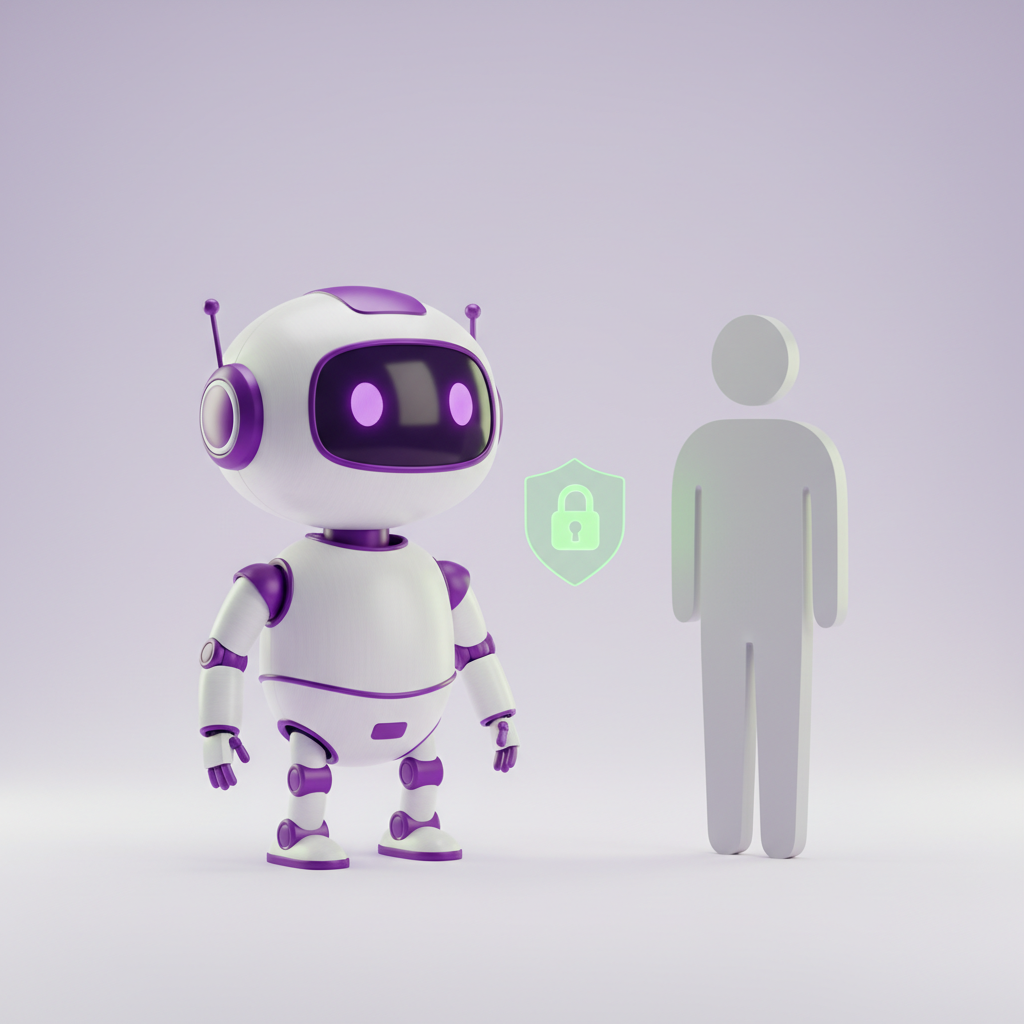 On the robot — recognized locally, the faceprint stays encrypted and never leaves.
  Out to the broker web — phoned home, matched to your web identity, and sold on.
 Why a Robot Needs Your Face
A home robot has to distinguish its owner from everyone else for two separate reasons, and both are legitimate:
- Personalization. It should greet you, follow your preferences, respond to your voice, and pick up where you left off — not treat every person identically.
- Authorization. This is the safety-critical one. A robot that can unlock a door, share your calendar, read a message aloud, or carry out a spoken command must know it's you asking — not a visitor, a delivery driver, or an intruder. Recognizing the household is how a robot refuses to obey a stranger.
Face is the natural sensor for this: it works hands-free, at a distance, without you stopping to authenticate. A local faceprint — a numeric template of your face — lets the robot answer "is this my owner?" in a fraction of a second. Paired with an on-board language model for understanding requests, that's a genuinely useful, genuinely private machine. The question is only ever where that faceprint lives.
The Right Way: Offline, On-Device, Encrypted
The correct architecture already exists, and you're probably carrying it. When you set up Face ID, your phone builds a mathematical template of your face and locks it in a secure enclave on the device. The raw images are discarded. The template never leaves the phone, never syncs to a server, and is useless to anyone who steals the file. Recognition happens entirely on the chip in your hand.
A well-built robot should work exactly the same way, and modern hardware makes it possible:
- A local model runs the intelligence. An offline, on-device LLM handles understanding and conversation without a round-trip to anyone's cloud. It works when your internet is down, and your household commands aren't logged on a server.
- The faceprint is stored on the robot, encrypted at rest. A template, not photos. Held in secure storage, tied to the device, unreadable if the drive is pulled.
- Recognition is fully local. The comparison of "face in front of me" against "enrolled owner" happens on the robot's own processor. Nothing about your face is transmitted to make that decision.
This isn't a privacy luxury — it's also just better engineering. On-device recognition is faster, works offline, and has no cloud database to breach. A robot built this way can know your face intimately while telling the outside world nothing.
The Robot That Phones Home
The tempting shortcut is the cloud. On-device recognition needs decent silicon; it's cheaper to ship a thin robot that streams what its cameras see to the maker's servers and lets a datacenter do the thinking. Plenty of "smart" cameras and assistants already work this way.
The moment that happens, the calculus flips:
- Your face is now uploaded and stored in an infrastructure you don't control, governed by a privacy policy that can change with a version update.
- Everyone the robot sees is enrolled — housemates, guests, the neighbor who stops by — often without meaningful consent.
- The template becomes a business asset. "To improve our products" and "with trusted partners" are the phrases that turn your household's biometric presence into a data stream with commercial value.
A cloud-dependent robot doesn't just risk a breach. It creates a permanent, centralized record of who is in your home and when — the exact kind of database that, once it exists, gets subpoenaed, sold, leaked, or repurposed for something you never agreed to.
When a Robot Meets the Data-Broker Web
Here's the part that should genuinely worry you, because it's where robotics collides with the machinery this company fights every day.
A robot that only phones home to its maker is bad. A robot that connects to the data-broker web is a different order of problem. The face-search economy — PimEyes, FaceCheck.ID, Clearview-style engines and the brokers who resell their output — has already scraped billions of public photos and built faceprints for hundreds of millions of people. If a robot matches faces against that, it doesn't merely recognize you as "owner #1." It looks you up.
That's the scenario in the red half of the diagram above. The robot's camera becomes a new collection point for an economy that was previously limited to what it could scrape from the open internet. Now it has a device inside your home, watching in real time, tying your physical presence to the faceprint the brokers already hold. Not so good.
None of this requires a villain. It only requires a maker who chose the cheap architecture and a supply chain that treats "enrich this face against a third-party database" as a feature. The safeguard can't only be trusting every vendor forever — it has to include controlling what there is to find.
What Good Biometric Safety Looks Like
As these devices arrive, this is the checklist worth demanding from anything with a camera that claims to know you. A trustworthy robot should be able to say yes to all of it:
- On-device only. Faces are recognized on the robot's own hardware, not streamed to a server.
- Templates, not images. It stores an encrypted faceprint, not a library of photos of your household.
- No cloud upload of biometrics. Your face data is never transmitted, for any reason, including "product improvement."
- No third-party or broker matching. It never checks a face against external face-search databases. Recognition is limited to the people you chose to enroll.
- Owner-controlled and revocable. You enroll people deliberately, you can see who's enrolled, and you can delete any template — and the raw model — permanently.
- Works offline. If it can recognize you with the internet unplugged, its intelligence lives where it should.
"Works offline" is the tell. A robot that still knows you with the Wi-Fi off is keeping your face where it belongs. One that goes blank without a connection is doing its thinking somewhere you can't see.
What You Can Do Now
You can't yet audit the firmware of every robot that will ship this decade. But you can control the thing that makes the broker path dangerous in the first place: whether your faceprint is sitting out on the web to be matched at all.
This is the quiet payoff of getting your face out of the search engines today. If your faceprint isn't in PimEyes, FaceCheck.ID, Lenso.ai and the rest, then a device that tries to look you up against the broker web comes back with nothing. The same defense that stops a stranger from turning your photo into your name also starves tomorrow's over-connected robot of anything to enrich you with. Whether the thing scanning your face is a website, an airport gate, or a machine in your hallway, the protection is identical: don't be in the database.
Home robotics can be genuinely great — offline, encrypted, and loyal to the household that owns it. The line to hold is simple, and it's the same line we've held since day one: your face is yours, and it should never quietly become a row in someone else's market.
Keep your face out of the databases a robot could query.
FacePrivacy removes your faceprint from PimEyes, FaceCheck.ID, Lenso.ai and the other major face-search engines — and keeps it removed — so there's nothing on the broker web for any device, camera, or crawler to match you against.
Protect your face →