On 29 January 2026, Apple acquired the Israeli startup Q.ai. The Financial Times reported the price at close to $2 billion, which would make it Apple's second-largest acquisition after Beats in 2014; other outlets have put the range at $1.6 to $2 billion. Apple, as it almost always does with acquisitions, said nothing about its plans. Everything below is either reported by named outlets or drawn from the company's own patent filings, and we have marked which is which.
What was announced
Q.ai was founded in 2022 and backed by Kleiner Perkins and GV, Google's venture arm. Its three founders — Aviad Maizels, Yonatan Wexler and Avi Barliya — are joining Apple with the company. The deal was covered by TechCrunch, Bloomberg and The Times of Israel, among others.
That is the whole confirmed story. No Apple executive has described what the technology will be used for, and no product has been announced.
What Q.ai builds
The company works on imaging and machine learning, with two strands that keep appearing in the reporting. The first is audio: interpreting whispered speech and cleaning up voice in noisy places. The second is the one that brought us here — reading the minute movements of the skin and muscles of a face to work out what someone is saying, including when they are barely making a sound. The shorthand in the coverage is "silent speech."
Think of it as lip reading taken several steps further. Not the visible shapes your mouth makes, but the small muscular activity underneath, measured precisely enough to reconstruct words from it.
Patents are not products
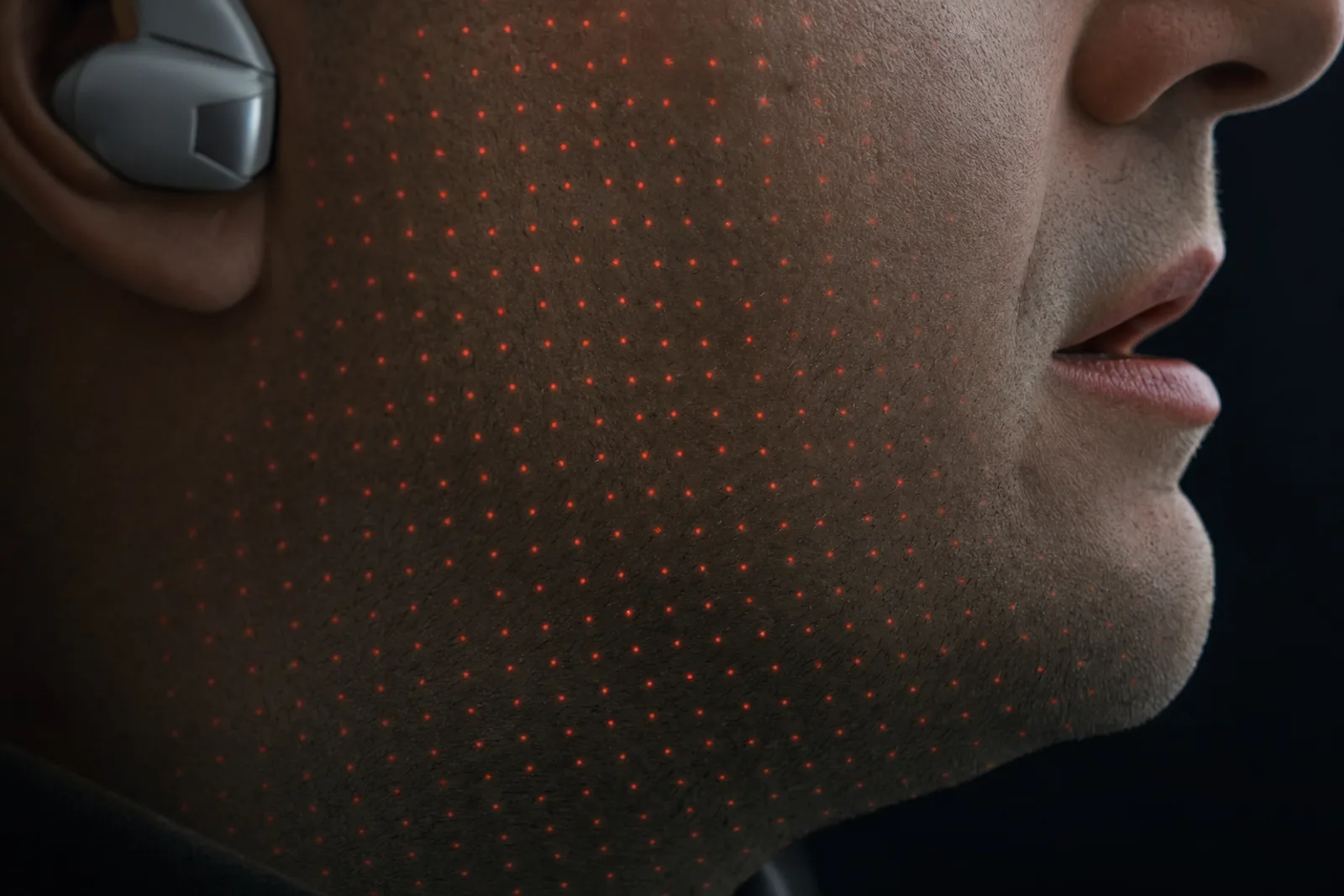
Much of the detail circulating about Q.ai comes from its patent filings, which describe head-mounted systems that project optical or laser light onto the face to detect tiny muscle activity. That detail is real and it is public. It is also worth holding lightly.
A patent records what a company explored and wanted to protect. It is not a roadmap, and companies patent far more than they ship. Apple in particular holds patents on a great many things that never reached a shelf. When you see a description of face-scanning laser hardware attributed to this deal, that is a filing being described, not a device that exists.
The PrimeSense thread
The most interesting verified fact in the story is about the founder rather than the technology. Aviad Maizels previously founded PrimeSense, the 3D-sensing company Apple bought in 2013 for a figure widely reported around $350 million. PrimeSense's depth-sensing work became central to Face ID, which is how a modern iPhone knows it is looking at your face and not a photograph of it.
So the person who sold Apple the sensing behind Face ID has now sold it a second company, one that reads faces at a finer grain. Whatever Apple does with it, that is a coherent line of development rather than a coincidence, and it says something about where the company thinks input is going: away from screens and voices, toward the body.
What this is not
Here is where it is easy to sell a story we do not believe. This is not facial recognition in the sense that matters for the work we do, and treating it as such would be dishonest.
Face search identifies you. It takes a photograph, measures the geometry of your face, and matches it against an index built by scraping photographs from the web, so that a stranger with one picture can arrive at your name. Q.ai's technology, as reported, does something else entirely: it reads movement to work out what you are trying to say. It is an input method. Sitting between it and a face-search engine are a different purpose, a different measurement and a different place for the data to live.
We have written before about the difference between face unlock and face search, and this falls on the unlock side of that line. A sensor that watches your face on your own head, to do something for you, is not the same as a database that holds your face so other people can look you up. Both involve your face. Only one of them makes you findable.
What is worth watching
None of that makes the deal uninteresting, and there is a real question underneath it, which is where this kind of measurement lives.
Face ID does its work in the Secure Enclave on the device, and the faceprint never leaves it. That design choice is the reason Face ID is defensible while a scraped face-search index is not. If facial-muscle sensing follows the same pattern, it stays a feature. If any of it were to become something transmitted, retained or trained on, it would be a new category of biometric data about how a person speaks and moves — and worth asking hard questions about at that point, not before.
Right now there is nothing to ask about, because there is no product. What we would say is this: watch for the answer when a device is announced, and expect a clear statement about on-device processing. The absence of one would be the thing to notice.
Meanwhile the exposure that already exists is unchanged by any of this. The photographs of your face sitting in face-search indexes today were put there by crawling the public web, and they will still be there whatever Apple ships next year.
Your face is already indexed. That part is not speculative.
FacePrivacy finds which face-search engines return your face, files removal requests with each of them, checks the result, and keeps filing as they re-crawl.
Protect your face →