The wall is deep blue and the thing framed on it is not a painting. It is two pages out of a fifty-year-old magazine, mounted with the same care as the canvases in the next room, and most people walk straight past it. They are the reason one of the paintings in the building works at all. They also contain a finding about your face that has aged in a direction nobody intended.
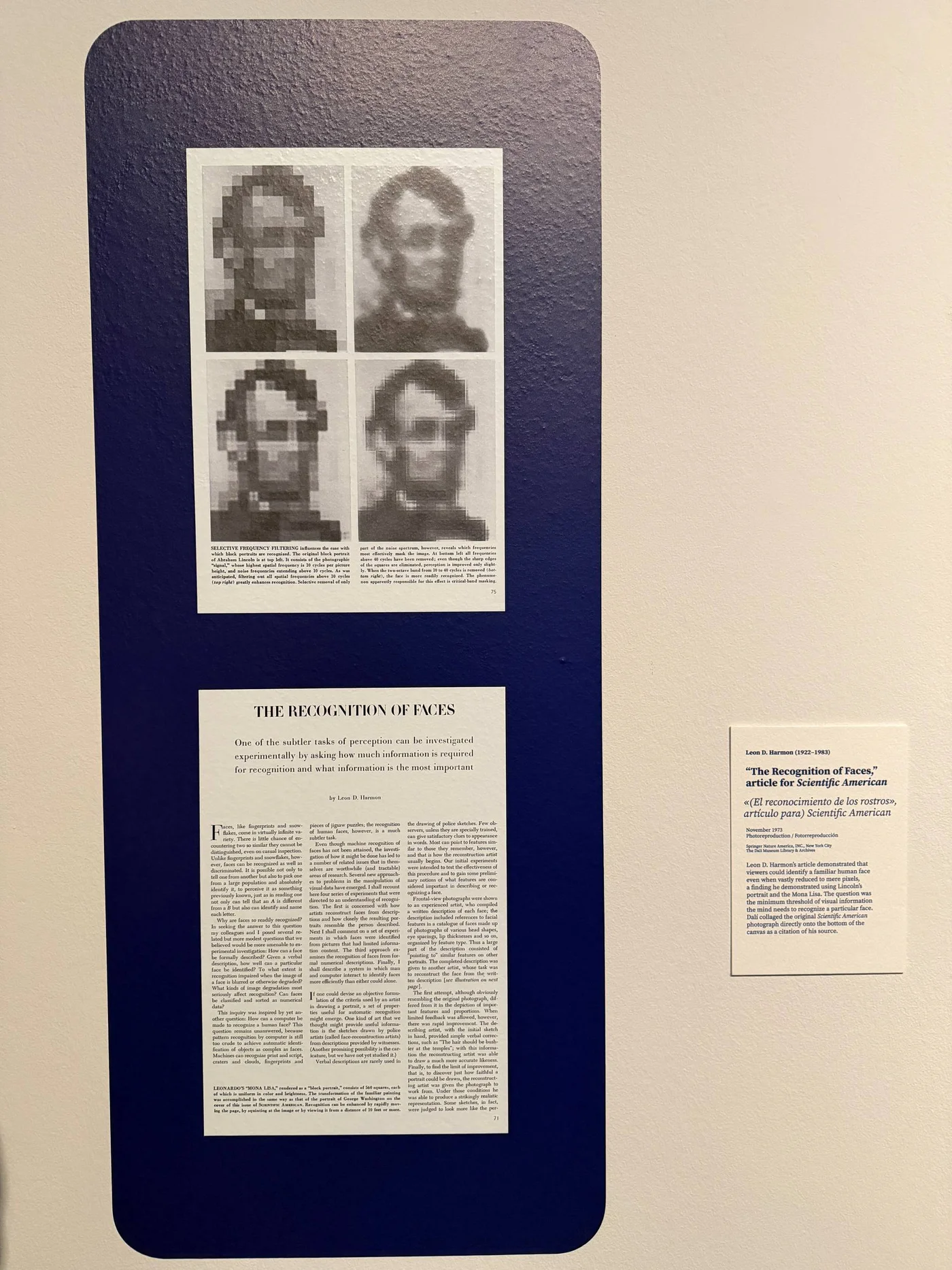
Look at the top left panel for a moment. It is barely a picture. Somebody took a photograph of a president and smashed it into a mosaic of grey tiles, the tiles are enormous, and the whole thing looks like a fax sent through weather. And yet there he is. The beard. The hollows under the eyes. You would not mistake him for Washington, or for the man standing next to you in the gallery.
The label is the part that turns a curiosity into a story. It notes that Dalí collaged the original magazine photograph directly onto the bottom of one of his canvases, as a citation of his source. An artist footnoting a scientist, in paint.
What is actually on the wall
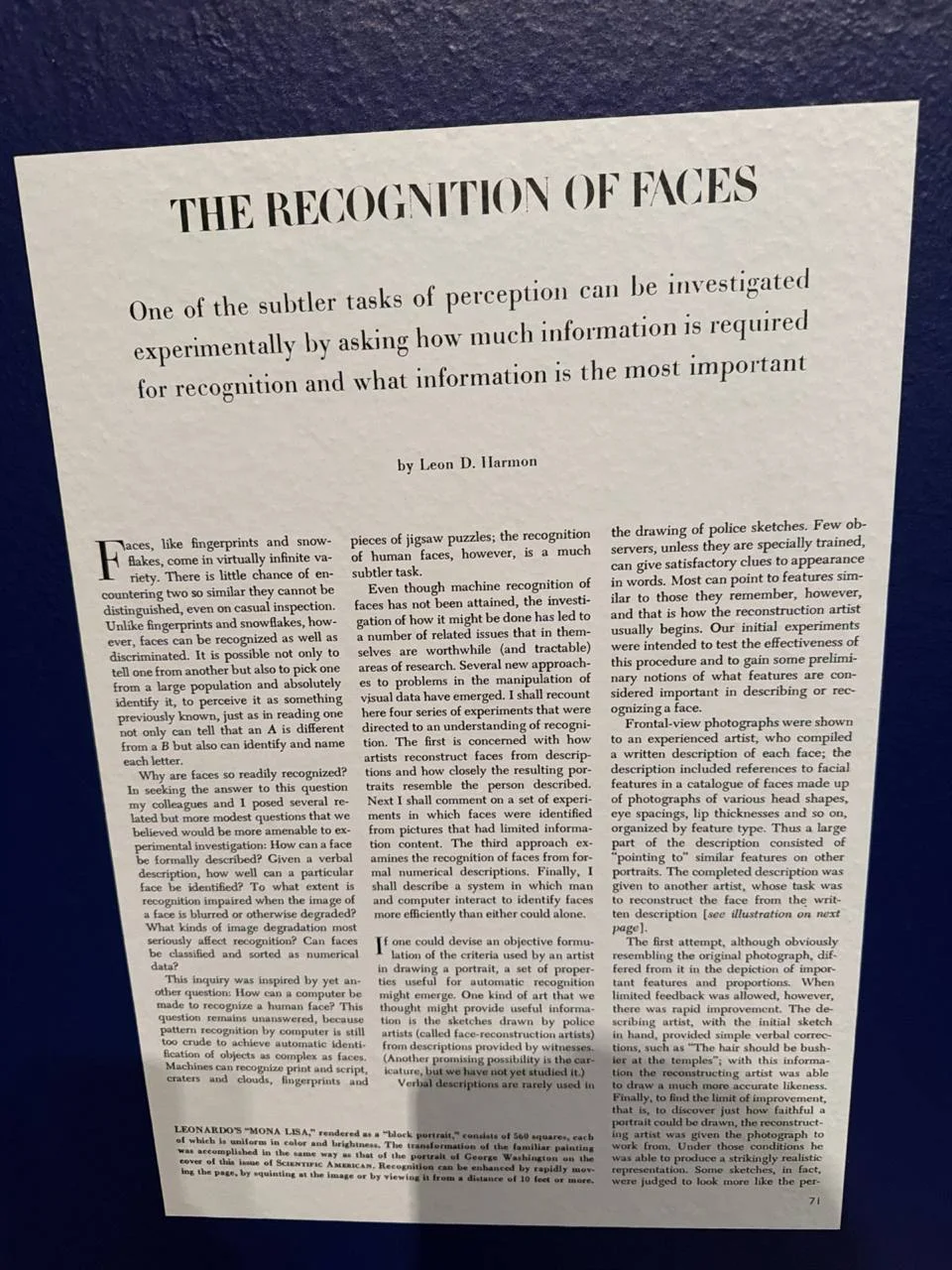
The article is The Recognition of Faces by Leon D. Harmon, published in Scientific American in November 1973. Harmon was a researcher at Bell Labs, and the piece is a plain-spoken account of four sets of experiments about how people identify one another.
The upper frame holds the image most people have seen without knowing where it came from: Abraham Lincoln rendered as a grid of coarse grey squares. Four versions sit side by side, each processed differently, and the caption discusses which kinds of visual information can be stripped away before the face stops being Lincoln.
Harmon also applied the same treatment to the Mona Lisa, reducing Leonardo's painting to 560 uniform squares. Blur your eyes at it, or walk backward across the room, and she reassembles.
He opens the article by drawing a line most of us never think to draw. There is telling faces apart, and there is naming one. A stranger can be perfectly distinct from every other face in the room and still mean nothing to you. Recognition is the rarer trick: not that this face differs from that one, but that this particular arrangement of shadow belongs to somebody, and you know who, and you knew it instantly.
The block portraits settle both questions at once, which is the quiet brilliance of them. They tell you who the man is. They tell you, just as firmly, who he is not.
The question Harmon was asking
Strip the framing away and the experiment is a subtraction problem. Start with a photograph of a face. Remove information from it, systematically and measurably. Keep going until people can no longer say who it is. Whatever survives that process is what recognition actually depends on.
The result surprised people, and it still surprises people, which is why the image endures. A face reduced to a few hundred blocks of flat grey remains identifiable. Not vaguely familiar. Identifiable, by name, to anyone who knows the person.
Harmon's second finding is stranger and more useful. The block portrait becomes easier to recognise when you degrade it further, by squinting or defocusing or backing away. Squint at the panel and Lincoln rises out of the mess like something surfacing. You would swear you were destroying information. You are only removing the wrong kind. Those hard square edges were never part of him. They were noise wearing his shape.
Why a surrealist cared about a perception paper
Dalí read the article and saw a technique rather than a study. In 1976 he painted Gala Contemplating the Mediterranean Sea Which at Twenty Meters Becomes the Portrait of Abraham Lincoln (Homage to Rothko), which is exactly as literal as the title suggests.
Stand close and the canvas is his wife Gala, nude, facing a window onto the sea. Walk back across the gallery and the same paint resolves into Lincoln's face filling the entire frame. Nothing changes but your distance from it.
Dalí had been making double images for decades, faces built from other objects that flip between readings. Harmon's paper handed him something he had been circling: a rigorous account of why the trick works at all, and a demonstration that the threshold for recognition is far lower than anyone assumed. So he built a painting on it, and glued the source page to the canvas.
The homage in the title is to Mark Rothko, who had died in 1970, and the picture carries that weight too. The sun in the window reads as an ascending figure. The recognisable face at the far end of the room belongs to an assassinated president. It is a painting about seeing, and also a painting about death, and the museum lets both stand.
Two truths, twenty meters apart
Museums are good at holding several true things at once. You can stand in front of one object and read it as art history, as biography, as a technical document and as a warning, and none of those readings cancels the others.
What makes the Dalí such a good object is that it refuses to have one answer. Close up it is genuinely Gala. Far away it is genuinely Lincoln. Neither viewing is the mistaken one, and no amount of staring reconciles them, because the information supporting each reading exists at a different scale.
You cannot see both at once. You can only know that both are there.
The wall behaves the same way. In 1973 the article was an optimistic document about the robustness of human perception, a small marvel about how good we are at each other's faces. Standing in front of it in 2026, the identical sentences describe the operating principle of an industry, and the marvel has an edge to it. Same page. Same words. Different distance.
The finding, read from where we are standing
Here is the part worth carrying out of the building.
Harmon established that a face survives extreme degradation, and he was describing people. Human vision, human recognition, a brain that has been sorting faces since before it could speak. Even for us it is easy. We soften our eyes until only the broad structure is left, and something older than language says Lincoln before we have consciously decided anything.
It is easier still for a machine, and the reason is worth being precise about.
A face-recognition model never squints, because it was never looking. It measures. It takes the same coarse structure Harmon found hiding under the noise, the spacings and proportions and the relationships between shadowed regions, and writes them down as numbers. A face becomes a list of coordinates. Recognition becomes arithmetic: how near is this list to that one.
Which means the limits we work under do not apply to it. We need contrast, scale, a reasonable angle and a moment to think. The model needs enough signal to compute its numbers, and the signal it wants is exactly the durable, low-frequency structure Harmon proved you can hardly destroy. Give it the details and the mathematics and that coarse arrangement holds up in conditions that would leave a person shrugging.
So it works on the security frame from the corner of a shop. On the photograph taken across four lanes of traffic. On the one where you are turned three quarters away, small, out of focus, twelfth from the left in a group of forty at somebody else's wedding.
Which quietly disposes of a comforting assumption. People sort their own photographs into the ones that count and the ones that do not. The good portrait counts. The blurry one surely does not, the tiny one in the corner is not really them, the dark one is too dark and the old one too old. It is a reasonable instinct and it is comprehensively wrong, and a man demonstrated as much in 1973 with a picture of Lincoln made of grey squares, hanging now on a blue wall in Florida while people file past it on their way to the melting clocks.
There is no resolution below which a photograph stops being you. The ones you never thought to worry about are working exactly as well as the good ones.
The rights of man to his own face
Elsewhere in the same building hangs a manifesto Dalí printed in 1939. The organisers of the New York World's Fair had told him he could not put a Venus with the head of a fish on the front of his pavilion, because a woman with the head of a fish was impossible. He responded in the most Dalí way possible, which was to print a manifesto and give it the title Declaration of the Independence of the Imagination and the Rights of Man to His Own Madness.
He was defending his artwork there, not his face. Worth saying plainly, because the two are not the same thing.
But the complaint underneath it is one you might recognise. Somebody else decided how he was going to show up in the world. They did not ask him, and as far as they were concerned that settled it.
Here is the difference between his problem and ours. Dalí had someone to be angry at. There was a committee. It had a name and an office and a door, and he could stand outside it waving pamphlets. That is why the manifesto is so funny and so furious. He knew exactly who was going to read it.
Face search has nobody like that. No committee ever met about your photograph. Nobody looked at it and decided anything. A crawler found a picture someone else had posted, a model measured your features, and a row appeared in a database. There is no one to shout at, which is an odd sort of problem to have, because anger usually wants an address.
The museum does not spell any of this out. It puts a paper about how little of a face you need in one room, and a manifesto about refusing to let other people define you in another, and lets you walk between them.
Dalí got to answer with a printing press. We answer with removal requests, sent again each time the crawlers come back around. Less romantic, but it is the version of the argument available to us.
The bad photos count too.
FacePrivacy finds where your face is indexed across the major face-search engines, files removal requests, and keeps filing as they re-crawl.
Start protection →Photographs taken at the Dalí Museum. The framed pages are from Leon D. Harmon, “The Recognition of Faces,” Scientific American, November 1973 (Springer Nature America, Inc.), held by The Dalí Museum Library & Archives.