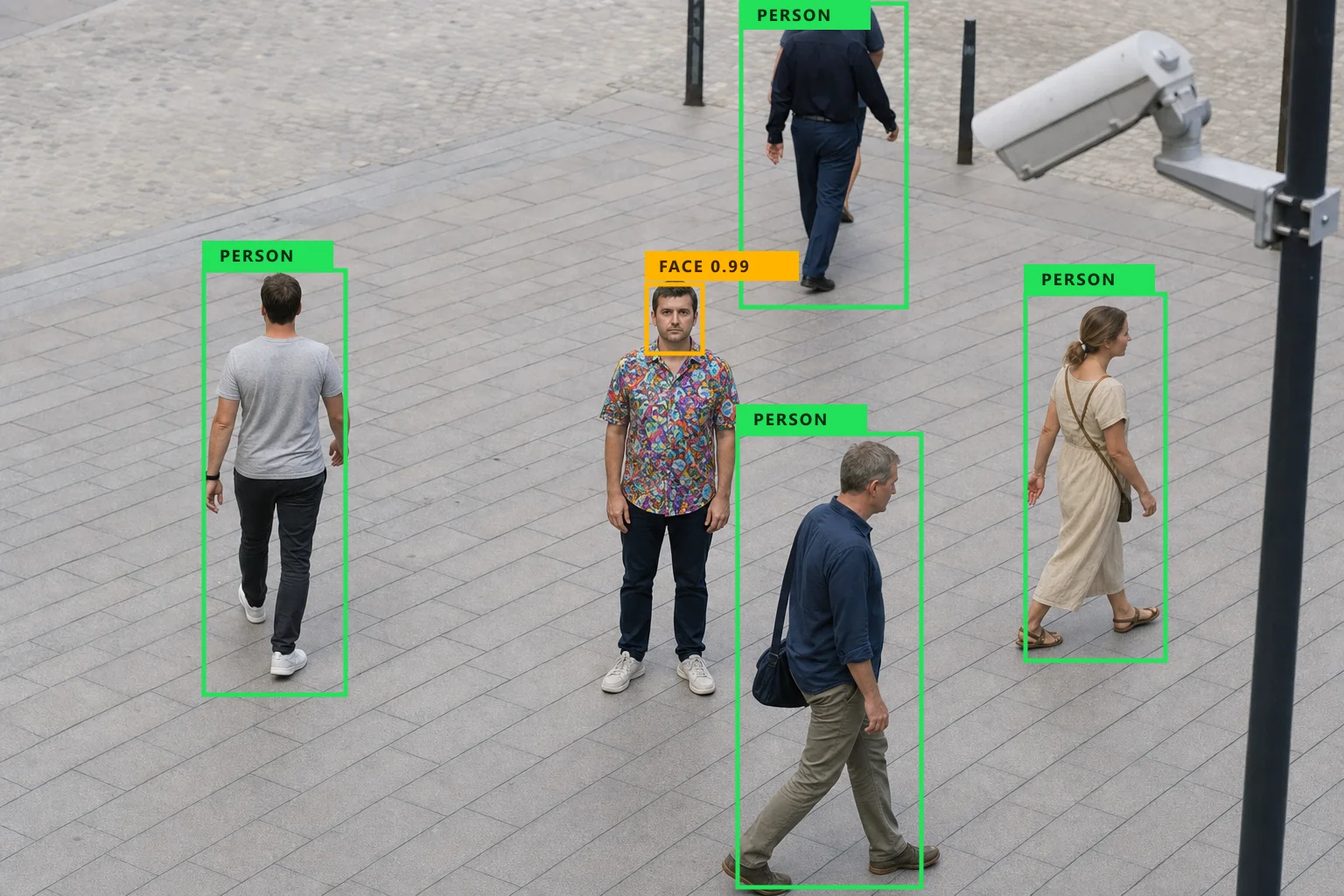
The project is called Digital Camouflage, by the Berlin artist Simon Weckert — the same person who once made Google Maps declare a traffic jam by pulling a wagon of 99 phones down an empty street. This time it is a garment: a shirt printed with a pattern engineered so that computer-vision systems watching public space fail to register the person wearing it. In his demonstration footage, everyone on the square gets a green box. The man in the shirt gets nothing.
The shirt
The pattern is not random noise. It is an adversarial texture — a print built on published research into fooling person detectors in the physical world, engineered to target exactly the features a detection model looks for when it searches a frame for a human figure. To a person, the wearer is obviously there. To the model, the statistical signature that means "human" never assembles.
Weckert demonstrates it against YOLO, the open-source detector that a large share of real-world video analytics is built on. And he is refreshingly honest about the boundaries: his own page says the work makes no claim about any specific government system, precisely because nobody outside can test them, and that no pattern can promise to defeat every system under every condition. In his words, it is not a tool for evading the police and not a promise of anonymity. Proceeds go to digital civil rights organisations. As a piece of engineering and as a piece of commentary, it earns the attention it is getting.
Why it works
A person detector does not see a person. It sees an arrangement of edges, textures and shapes that, during training, reliably co-occurred with the label "person." An adversarial pattern floods that arrangement with contradictory signals — features that pull the model's confidence in every direction at once, so the score never clears the threshold that draws the box. The wearer isn't hidden. The wearer is illegible.
That is a real effect, reproducible and well documented. It is also a narrow one, and the narrowness is the part that matters if you are thinking of this as protection rather than as art.
Why your face still gives you away
Here is the distinction the demonstration quietly skips past: person detection and face detection are different systems looking for different things. The shirt attacks the first. It does nothing about the second, for the simple reason that a face detector never looks at your shirt. It looks for a face — eyes, nose, the geometry of a head — and the shirt's wearer presents his, uncovered, to every camera he passes.
We spent a decade building these pipelines before we started getting people out of them, so we can be concrete. A surveillance stack is layered: one model may find people, another finds faces, another turns a found face into a measurement and matches it against a database. Defeat the person detector and a face detector running on the same footage still fires. Defeat both on one system and the next system, trained differently, sees you fine. And the face-search engines we deal with every day — the ones that match a photo of you to your name — don't watch cameras at all. They index photographs that are already online. No shirt reaches backwards into an index.
It depends on the algorithm
Adversarial patterns are also brittle in a way the demo format hides. A texture optimised against one model transfers unreliably to another: the print that blinds one detector can be a mild inconvenience to a second and completely invisible to a third. Angle, distance, lighting and how the fabric folds all erode the effect. Update the model — and vendors update constantly — and the pattern may simply stop working, with no way for the wearer to know. Weckert says as much himself. The shirt is a demonstration against a known, testable, open-source detector, offered in a world where the systems that matter are closed and untestable.
A start, not a solution
None of this is a knock on the project. Weckert's stated purpose is to make invisible systems visible — to force a conversation about software that watches public space without anyone outside being able to audit it. Judged as that, it succeeds completely, and the fact that a shirt can blind a widely deployed class of detector at all is a point worth making loudly.
But as personal protection, it covers one layer of a many-layered problem, unreliably, for exactly as long as you are wearing it. Your face is the identifier that follows you into every frame, and the photographs of it already sitting in face-search databases are the copies that actually connect a stranger's camera to your name. That exposure doesn't care what you wear tomorrow.
The shirt handles one camera. We handle the databases.
FacePrivacy finds which face-search engines return your face, files removal requests with each of them, verifies the result, and keeps monitoring as they re-crawl.
Protect your face →