Disney: Disneyland Park and Disney California Adventure
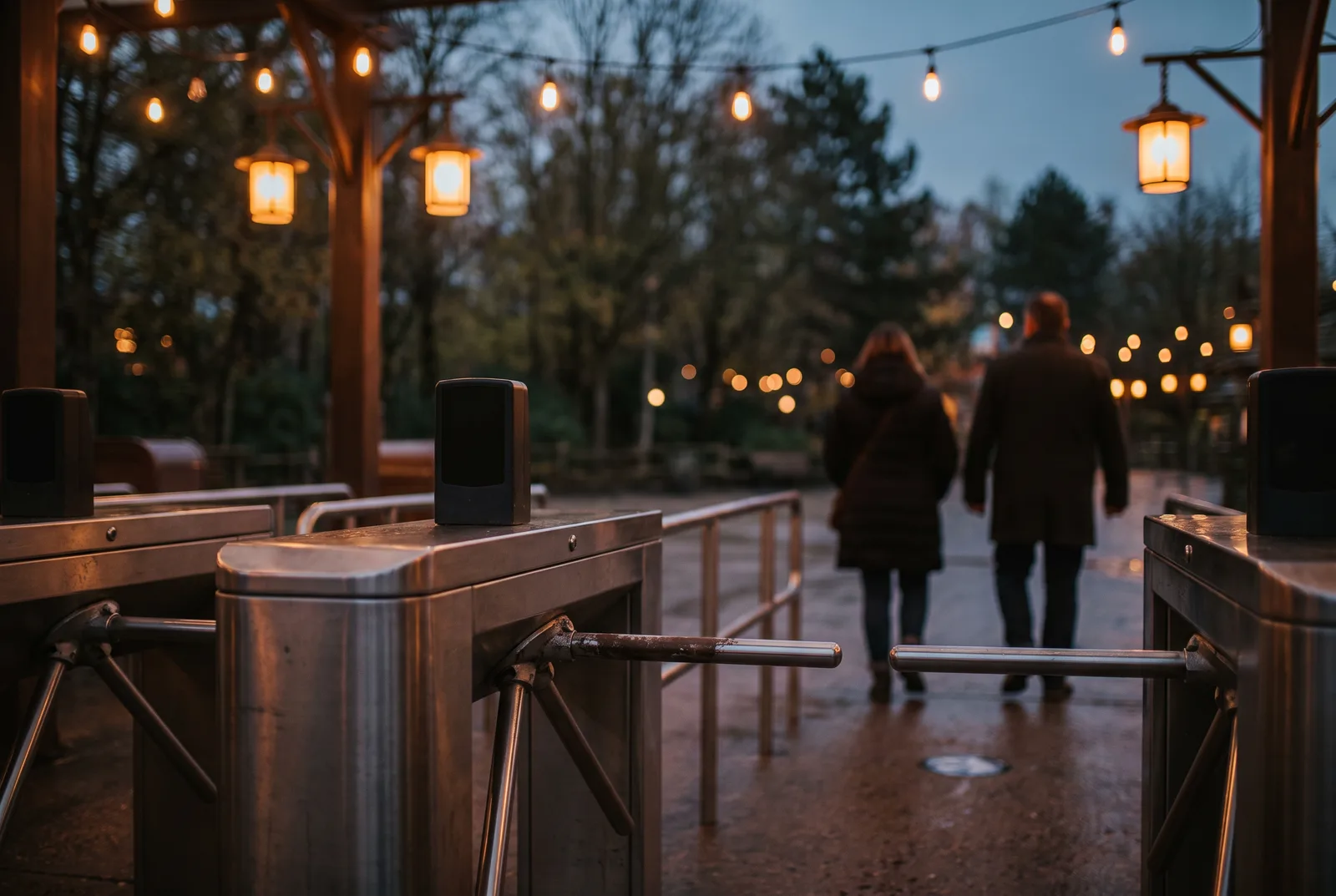
Since spring 2026 the main entrances at both Anaheim parks have lanes that match your face to the photo Disney saved the first time you used your ticket or pass (Biometric Update, April 2026).
- What it keeps: a numerical template of your face, not a photo you could look at. Disney says it deletes the values within 30 days of creation, except where data must be kept for legal or fraud-prevention reasons (Disney Privacy Center).
- How to opt out: at the main entrances along the Esplanade, choose a lane showing the no-facial-recognition icon. A Cast Member validates your ticket by hand. Your picture may still be taken, but Disney says it is not processed biometrically.
- Under 18: a parent or guardian has to consent before the face lane can be used.
The opt-out lane exists at every entrance, though signs explaining it in the parking structures only went up on 21 April 2026, months after the lanes did (State of Surveillance). If you cannot find the icon, ask the first Cast Member you see for the manual lane.
Cruise lines: Carnival, Royal Caribbean, Princess and others
The camera you meet walking off a ship at a US port belongs to Customs and Border Protection, whatever brand is printed on the stand. Carnival runs it at nine US homeports, and Royal Caribbean and Princess use it at ports including Miami, San Juan and San Diego (CBP).
- What it does: compares your live photo to the passport or visa photo the government already holds.
- How to opt out: US citizens and some other travellers can ask the CBP officer for a manual document check. Carnival also lets you set your choices for embarkation, debarkation and onboard photo services during online check-in or in the HUB app (Carnival).
Airlines: Delta, United, American, Alaska, Southwest
All five big US airlines now support TSA PreCheck Touchless ID at 65-plus airports. It is opt-in only, and it runs on your passport photo through CBP’s matching service, not on anything the airline stores.
- How you got in: you added a passport number to your frequent-flyer profile and ticked opt-in, or agreed in the airline app or Google Wallet.
- How to get out: the same profile. Delta says it stores no biometric data itself and that customers can opt out at any time (Delta).
- The checkpoint camera is separate. That one is TSA’s, and you decline it by saying so at the podium. Details in what TSA does with your face scan.
Stadiums: every NFL team, and a growing list of others
All 32 NFL teams use Wicket’s facial authentication for credentialed staff and media entering restricted areas (Biometric Update). For fans, the same company sells “Express Entry” lanes, and says it works with more than 50 professional teams across leagues.
- Opt-in by design: fans enrol a selfie linked to their Ticketmaster account, as at the Buccaneers’ Raymond James Stadium. Nobody is scanned at the ordinary turnstile.
- How to opt out: do not enrol, or delete the enrolment in the team app. Use the regular gate.
Madison Square Garden: the one used to keep people out
MSG Entertainment uses facial recognition at the Garden, Radio City and its other New York venues to identify and turn away lawyers from firms with active lawsuits against the company. The New York Attorney General wrote to MSG in 2023 questioning whether the policy broke state civil-rights law (NY AG). A state court later allowed the ban to stand, and bans were still being reported in 2025.
- There is no opt-out lane. The scan is the venue’s security screening, applied to everyone who enters.
- Your only lever is the venue’s biometric policy and, if you are in New York City, the local law that requires signs at the door.
Retailers: quiet, with one loud exception
When the ACLU asked 20 large chains whether they scan shoppers’ faces, most declined to answer (State of Surveillance). Two cases show what the answer can look like.
- Rite Aid ran face matching in hundreds of stores from 2012 to 2020, produced thousands of false matches that got innocent shoppers followed and accused, and was banned by the FTC from using the technology for five years in December 2023 (FTC).
- Wegmans put up signs in its Manhattan and Brooklyn stores in January 2026 saying faces, eyes and voices might be scanned, and admitted running face matching in a small fraction of stores to flag people accused of misconduct.
- How to opt out: in-store, you usually cannot. In Illinois, the Biometric Information Privacy Act requires written notice and a written release before a company can collect your face geometry, which is why Walmart, Home Depot and Lowe’s have all faced BIPA suits. New York City requires signs. Elsewhere, shopping somewhere else is the opt-out.
Meta: Facebook and Instagram
Meta switched off Facebook’s photo-tag face recognition in 2021, then brought face matching back in 2024 for two narrow jobs (Meta).
- Celeb-bait scam ads: if an ad appears to use a public figure’s face, Meta compares it to that person’s profile photos and blocks the ad if it is a scam. Public figures are notified and can opt out; in the UK and EU they opt in.
- Account recovery: a video selfie can prove you own a locked account. Optional, offered in the UK, EU and South Korea, and Meta says the face data is deleted as soon as it is no longer needed.
- How to opt out: for ordinary users there is nothing running on your photos to switch off. Choose the non-selfie recovery route if you are ever locked out.
Google Nest and Ring: your neighbours’ doorbells
“Familiar face” features let a doorbell owner name the people it sees. The owner controls it; the person on the doorstep does not. Both Google and Ring face lawsuits over the feature (BGR).
- If you own one: Google Home app, profile picture, Home settings, Subscriptions, Google Home Premium, Familiar face detection, then turn it off per camera and delete the face library. Google’s own help page reminds owners that some places require consent from the people being identified (Google Nest Help).
- If you are the visitor: there is no opt-out except asking the owner. Illinois and Texas restrict the feature, which is why it is unavailable there.
The one with no opt-out lane: face search engines
Every company above scans you for a moment, compares you to a photo you gave someone, and in most cases deletes the result within days. A face-search engine does the opposite. It has already collected photos of you from the open web, keeps them indefinitely, and lets anyone with a card run your face against them.
- No gate, no sign, no Cast Member. The scan happens whenever a stranger uploads your photo.
- The opt-out exists, but it is a form per engine, and it needs repeating because engines re-crawl. Our guides: PimEyes, FaceCheck.ID, Lenso.ai, and the full list.
- Or have it filed for you. Upload two photos and we file the requests with the major engines, track every reply, and re-file each month.
Common doubts
“If Disney deletes it in 30 days, why bother opting out?”
Many people will not, and that is a fair call. The lane exists for those who would rather not create the template at all, and it costs nothing but a manual ticket check.
“Does opting out slow me down?”
At Disney it is a manual ticket scan. At TSA it is the old ID check. At CBP it is a document check by an officer. None of them requires you to leave the line.
“Can you remove me from Disney, MSG or a store’s system?”
No. We file removals with face-search engines only, and we say so. For the companies above, the opt-out is at their gate or in their app, as described.
“What does it cost?”
US$9.99 a month, or US$7.99 a month billed annually. Cancel from your dashboard whenever you like. Web payments made through Stripe carry a 30-day money-back guarantee.
Opt out of the one that never asks.
Upload two photos. We file removal requests with the major face-search engines and re-file them every month.
Remove my face from search engines →