Where smart glasses are restricted so far
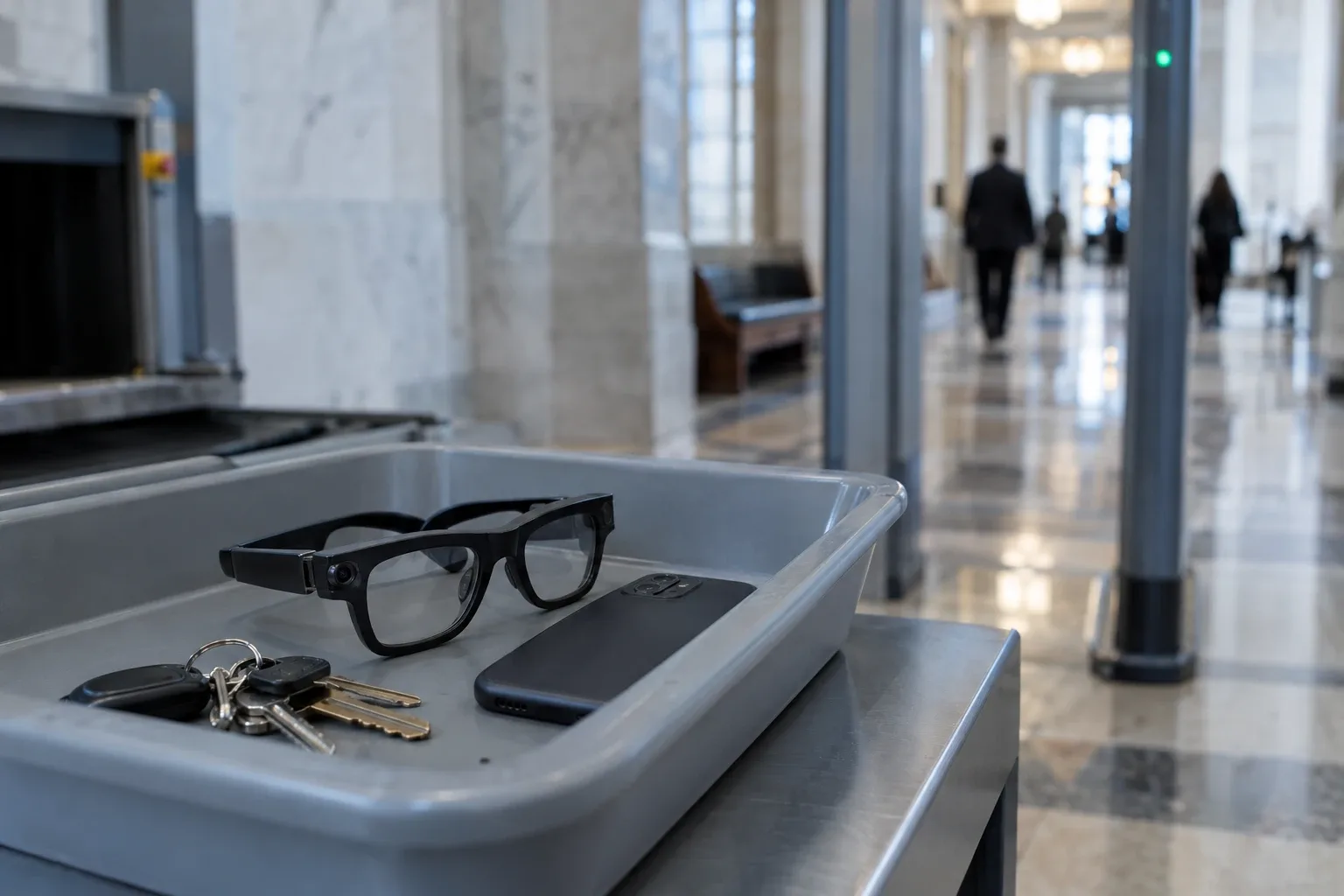
Most rules come from the places that run a building: courts, the military, councils with pools and libraries. These are the ones on record as of late October 2026, from Biometric Update’s October roundup unless another source is linked.
| Where | What the rule says |
|---|---|
| New York State courts | Smart glasses barred from court facilities since July 20, 2026 (Unified Court System memo). |
| Illinois Supreme Court | Added “smart eyewear” to its device policy on September 29, 2026. |
| US federal courts in Florida (Middle District) and Georgia (Northern District) | Banned, prescription models included. |
| Courts in England and Wales | Meta’s glasses barred from courts and tribunals. |
| US Air Force | Since January 2026, glasses with photo, video or AI features cannot be worn in uniform. |
| Canada’s Department of National Defence | Since July 2026, AI glasses prohibited in operations, security and high-security zones. |
| City of Sydney | Council voted in September 2026 to prohibit them at its leisure centres and libraries, with disability exemptions. |
| Brisbane | Non-consensual use of camera devices banned at all 21 council pools. |
| Norway | The government says it will propose a temporary ban in selected public places. |
Retail is moving too. Kmart Australia took its A$89 Anko camera glasses off online sale in October.
The investigations that are open
- Europe: the European Data Protection Board adopted a statement on smart glasses on October 13, 2026, confirming the GDPR applies when they capture identifiable people.
- France: the Paris prosecutor opened a criminal investigation into alleged filming without consent, and the CNIL started its own smart-glasses work in June.
- Germany: the group HateAid filed a criminal complaint over Ray-Ban Meta sales in August, which Frankfurt prosecutors are examining.
- Australia: the privacy regulator (OAIC) opened a formal investigation into the maker of the HeyCyan glasses app.
- Netherlands and South Korea: both privacy regulators are examining AI wearables and talking to manufacturers.
Why face recognition keeps coming up
The EDPB statement says the glasses allow “near invisible or hidden collection” of personal data, because they look like ordinary eyewear. It then names the bigger worry: using them together with facial or voice recognition poses “a high risk to the rights and freedoms in public spaces.”
- It has been done with off-the-shelf parts. In 2024 two Harvard students paired Ray-Ban Meta glasses with the face search engine PimEyes and people-search sites, and their phones showed strangers’ names and addresses within seconds (404 Media).
- Meta has tested it. WIRED reported in June 2026 that Meta licensed face recognition from Rank One Computing for a test version of the app behind its glasses. Meta removed the dormant code the day after WIRED found it (The Next Web). We covered the “NameTag” feature in Meta wants to put a name tag on you.
In both cases the name came from a face search engine, which matched the captured face to pages it had already indexed.
What a ban does not reach
- Public streets. No country on the list bans wearing the glasses outdoors. Norway’s proposal covers selected places only.
- Photos already taken. A rule at a pool or a court applies from the door inward and only from the day it starts.
- The search afterwards. A photo from glasses, a phone or a security camera can be uploaded to a face search engine anywhere, at any time.
Our earlier post, Courthouses Banned Camera Glasses. Sidewalks Didn’t., looks at who the court bans were written to protect.
What you can do this week
- Know the tell. Ray-Ban Meta glasses show a small white light on the frame while they record. If you see it and you object, say so. In a venue with a rule, tell staff.
- Search your own face. Upload a recent photo to a face search engine and see which pages come back. Our self-check walks you through it.
- Opt out of the face search engines. Each one has its own form and its own rules about which photos it accepts. Our guide to removing your face from PimEyes shows one of them step by step.
- Re-check after a few months. Engines crawl the web again and can index a new copy of your face.
Common doubts
“Is it legal for someone to film me with glasses in public?”
In the US, generally yes, the same as filming with a phone, though recording a private conversation can break wiretap laws. In Europe the EDPB says the GDPR can apply when the footage is shared beyond personal use. This is general information, not legal advice.
“Will the glasses recognise my face on their own?”
Not as sold today. Meta says it has made no final decision on face recognition. The risk today is the photo being run through a face search engine afterwards.
“Can FacePrivacy stop people filming me?”
No. We work on the step after the photo: we file opt-out requests with the face search engines we support and re-file them as necessary, so a photo of you leads a stranger to fewer pages.
“What does that cost?”
US$9.99 a month, or US$7.99 a month billed annually. Cancel from your dashboard whenever you like. Web payments made through Stripe carry a 30-day money-back guarantee.
Make a photo of you harder to put a name to.
Upload two photos. We file opt-out requests with the face search engines we support and re-file them as necessary.
Opt my face out of face search →Sources
- European Data Protection Board: Statement on smart glasses, adopted October 13, 2026
- Biometric Update: Smart glasses face widening bans, probes and privacy controls worldwide
- New York State Unified Court System: Amended prohibition against smart glasses
- 404 Media: Someone put facial recognition tech onto Meta’s smart glasses to instantly dox strangers
- The Next Web: Meta face recognition for its glasses came from a Pentagon contractor, WIRED reports